Home › Guides › HVAC website design
HVAC website design: built for the emergency call and the big decision
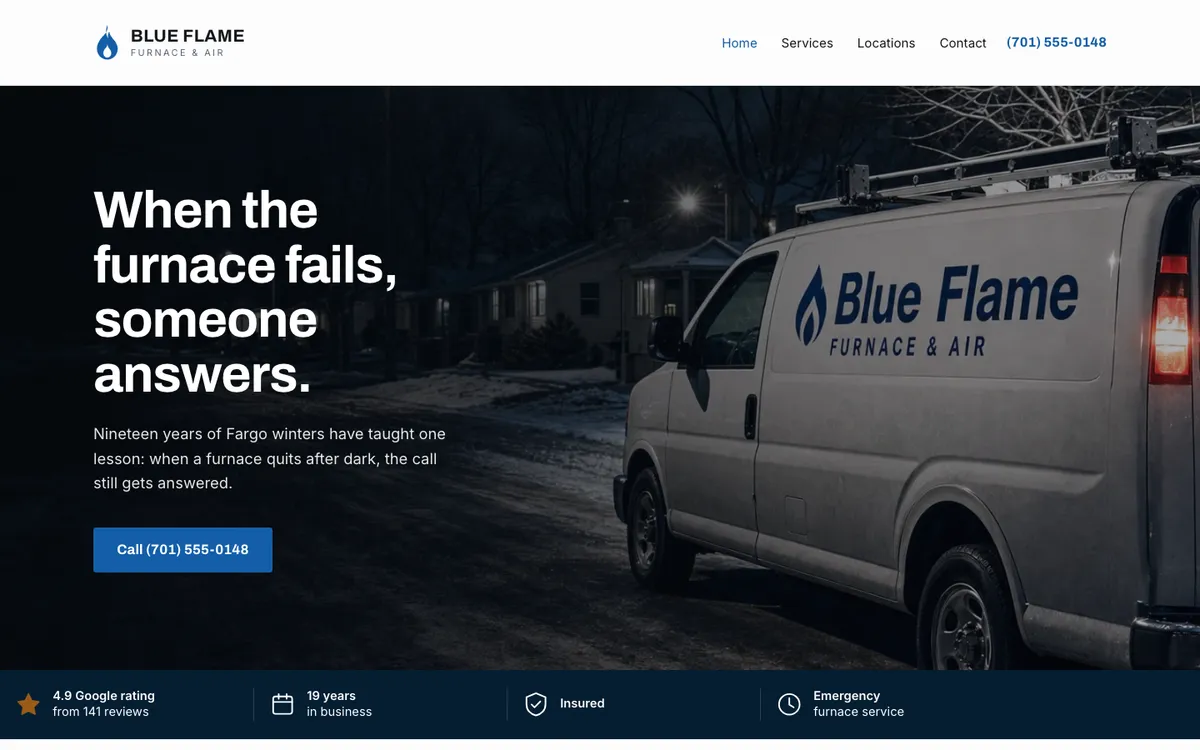
A no-cool call in July and a no-heat call in January are emergencies. A system replacement, most of the year, is a researched decision with a few-thousand-dollar price tag attached. One HVAC website has to be fast for the first kind of visitor and thorough for the second — on the same homepage.
Two seasons, two kinds of visit
Most of the year, an HVAC site is doing research-stage work: a system is getting old, someone is reading about SEER ratings and comparing two or three companies before they ever pick up the phone. Then the weather turns, and the exact same site needs to answer a different person entirely — the one whose air conditioner just died on the hottest day of the summer, or whose furnace quit at 11 p.m. in January. That visitor isn’t comparing anything. They’re looking for a phone number and a reason to believe someone will actually show up.
A site that only does one of these jobs loses the other kind of customer completely — the emergency caller bounces off a page that opens with financing details, and the researcher closes a page that’s nothing but a phone number and a stock photo of ductwork.
A page for each real decision
“AC repair” and “AC replacement” are two different searches from two different mindsets, even though they’re the same system. Built right, each core service gets its own page:
- AC repair — written for someone who wants a fix today, not a sales conversation about a new unit.
- AC replacement — written for the researched decision: what it involves, how long it takes, what changes in the house.
- Furnace repair — same emergency logic as AC repair, for the other half of the year.
- Heat pumps — increasingly its own search, separate from both furnace and AC pages, as more homeowners ask about them by name.
- Maintenance plans — the page that turns a one-time customer into a once-a-year one (more on this below).
- Indoor air quality — a smaller search, but a real one, and often the easiest upsell once you’re already in the house.
A homepage that blends all six into one “Our Services” paragraph can’t be matched to any one of those searches — which means it loses visibility on all of them, not just some.
Proof that matches the size of the decision
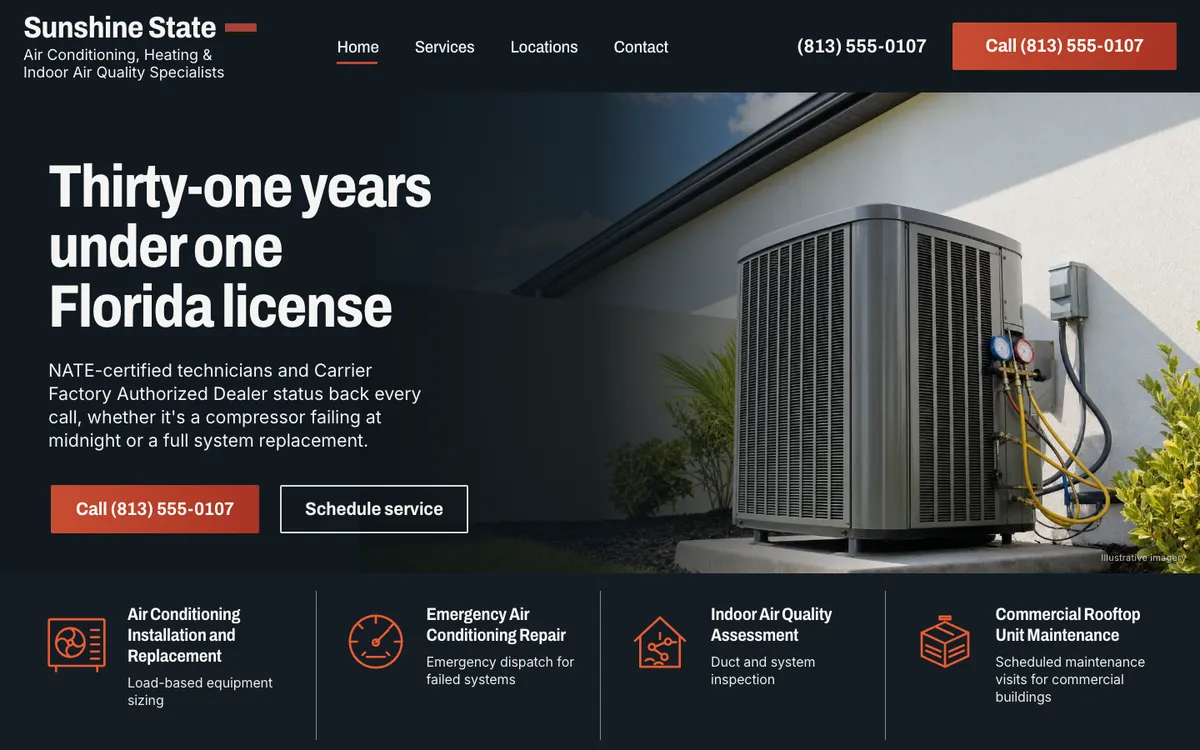
- A real credential, named and explained North American Technician Excellence (NATE) describes itself as “the nation’s largest non-profit certification organization for heating, ventilation, air conditioning and refrigeration technicians.” If your technicians hold it, or you carry a manufacturer’s factory-authorized dealer status, name it — don’t just claim “certified” with nothing behind the word.
- Financing, mentioned honestly If you offer it, say so on the replacement page itself, where the price question actually comes up — and say only what the terms really are. A vague “financing available” with no detail reads as a maybe, not a reason to call.
- A maintenance-plan page, not a footnote This is the one page built to bring a customer back every year instead of once — it earns its own explanation of what a visit includes, not a single bullet at the bottom of the services list.
Contractors licensed under a state board often carry the same advertising rule either way — in California, for instance, Business and Professions Code section 7030.5 requires a licensed contractor’s number on all forms of advertising, HVAC included. Check your own state board before assuming either way.
Build it before the rush, not during it
By the first real heat wave or the first hard freeze, many of the people searching already know who they’re calling — the comparing happened weeks earlier, while the weather was still ordinary and nobody felt rushed. A maintenance-plan page, a replacement page with real detail, and a current set of reviews need to already be live before the season turns, not written the week demand spikes.
The one thing that undersells a good HVAC company
- A replacement page that’s a photo and “Contact us for a quote” — nothing about brands, nothing about financing, nothing about what the estimate visit involves. It’s the single most expensive decision on the site, and the page that explains the least about it.
Common questions
What’s the busiest time for an HVAC website to already be working?
Before the extremes hit, not during them. By the first real heat wave or the first hard freeze, most searchers already know who they’re calling — the research happened in the weeks before, when the weather was still ordinary and nobody was in a hurry.
Should an HVAC company list the brands it installs?
Only the ones you can actually back up. A NATE certification or a genuine manufacturer dealer status is something a buyer can look into; a generic “we install all major brands” line asks for trust without giving a way to check it.
Does an HVAC site need a separate maintenance-plan page?
If you sell a maintenance plan, yes. It’s the one page on the whole site built to bring a customer back every year instead of once, and it needs its own explanation of what a visit includes and what it costs — not a single line at the bottom of the services list.
One page per service, built for you
Speedy Sites builds a page for every service and every area you cover, with tap-to-call on all of them and a leads inbox for what comes in. $0 today, the first 90 days free, then $99/month.
Build my website