Home › Guides › Plumber website design
Plumber website design: what gets the phone to ring
Some plumbing searches are a flood in progress. The rest are a fourteen-year-old water heater someone is quietly comparing quotes on. A plumber’s website has to answer both — fast enough for the first call, specific enough for the second.
Two different customers, same business
Water coming through a ceiling and a slow decision about repiping an old house are not the same search, and they don’t want the same thing from a website. One wants a phone number they can hit with a wet thumb in under two seconds. The other wants to read, calmly, what a repipe actually involves before picking up the phone at all.
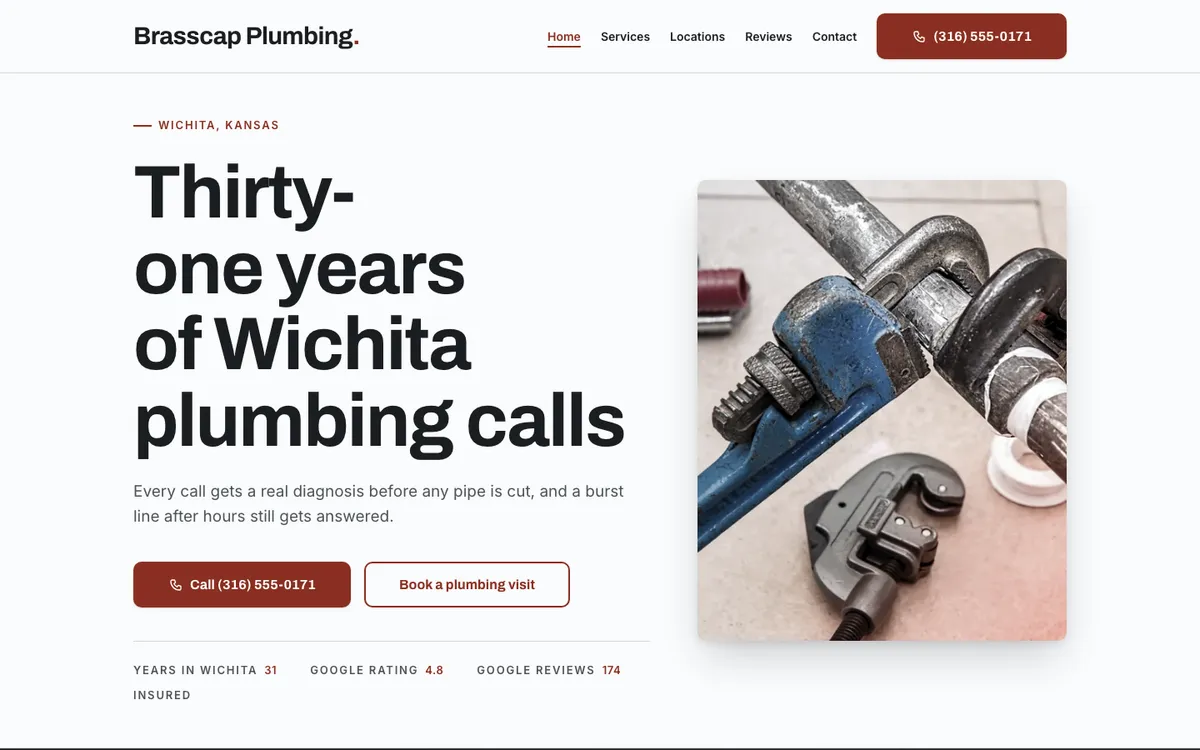
Plenty of plumbing sites are built for neither. There’s a logo, a stock photo of a smiling stranger in a branded polo who has never touched a pipe wrench on this job, and one page called “Services” that lists twelve things in a single paragraph. That page is too slow for the person with water on the floor and too vague for the person doing research — it serves nobody particularly well.
Give the real services their own pages
A search usually arrives attached to a problem: “water heater replacement cost” or “sewer line backing up into tub.” A page built around that exact job, with the signs that bring someone to it and what the visit involves, is the page a search engine can match to that phrase (our plain-English guide to how that matching works goes into the mechanics). It’s also the page that actually answers the research customer’s question, instead of making them guess whether you even do that kind of work.
Services worth their own page, for most plumbing companies:
- Drain cleaning — the job most likely to be a same-day call.
- Water heater repair and replacement — tank and tankless are different enough searches to deserve their own lines, even on the same page.
- Leak detection and repair — the search that brings in people who don’t yet know where the water is coming from.
- Sewer line repair and replacement — a bigger, scarier job; this page is where trenchless-vs-dig and camera inspection get explained.
- Repiping — almost always a researched decision, never an emergency; this is the page for photos, timeline, and what happens to the house during the work.
- Gas line work — only if your license covers it, and only described the way your license actually covers it.
Say 24/7 only if someone really answers at 2 a.m.
Round-the-clock service is one of the highest-value claims a plumbing site can make, and one of the easiest to get wrong. If a call placed at 2 a.m. genuinely reaches a person who can dispatch a truck, say so plainly — on the page about the job, and right next to the phone number, not buried as a small badge in the header. If what actually happens after hours is a voicemail and a callback in the morning, say that instead. A site that claims “24/7” and then doesn’t answer at 2 a.m. loses that caller twice: once on the night they needed help, and again when they remember exactly who let them down.
What the research customer checks before they call
- License and insurance, where it’s easy to find Not just in the footer in six-point type — next to the phone number, on the services pages, anywhere someone is deciding whether to let you into their house.
- Real reviews, not a polished-sounding summary of them A handful of genuine reviews, in the customer’s own words, reads as more honest than a banner claiming a rating with no reviews attached to check it against.
- The truck and the work, photographed for real A photo of your own van, your own tools, a finished job — it doesn’t need to be good photography. It just needs to be yours, not a stock library’s idea of a plumber.
The one thing that sinks a plumbing site
- A phone number that isn’t the first thing on the page, paired with a single “Services” page written to mention everything and built around nothing in particular. It can’t be found by a specific search, and it can’t answer a specific question — which means it loses the emergency caller to speed and the research customer to detail, in the same five seconds.
Common questions
Does a plumbing website need a separate page for every service?
Only for the jobs people actually search for by name — water heater replacement, drain cleaning, sewer line repair, repiping. A page built around one of those phrases can answer the specific questions that search brings with it. A single paragraph that lists everything can’t.
Do you have to put a license number on your plumbing website?
If you’re licensed in California, the state already requires it. Business and Professions Code section 7030.5 says a licensed contractor “shall include his license number in… all forms of advertising,” and your website counts. Check your own state board if you’re elsewhere — the rule isn’t the same everywhere.
Is it worth advertising 24/7 emergency service?
Only if it’s true. A caller who reaches voicemail at 2 a.m. after reading “24/7” on your site won’t call back, and won’t forget which company let them down. If after-hours calls really get answered and dispatched, say so plainly near the phone number, not just as a small badge in the header.
A plumbing site built this way
Speedy Sites builds a page for every service and every area you work, the tap-to-call button on all of them, and a leads inbox for what comes in. $0 today, the first 90 days free, then $99/month.
Build my website