Home › Guides › Landscaping website design
Landscaping website design: what sells when the work is visible
Landscaping is a trade where the result is sitting right there in the front yard, so a site that doesn’t show real work is wasting its best argument. It’s also a trade that runs on two different businesses at once — a one-time design job and a recurring maintenance route — and the site needs to sell both.
Photos are the product, so treat them that way
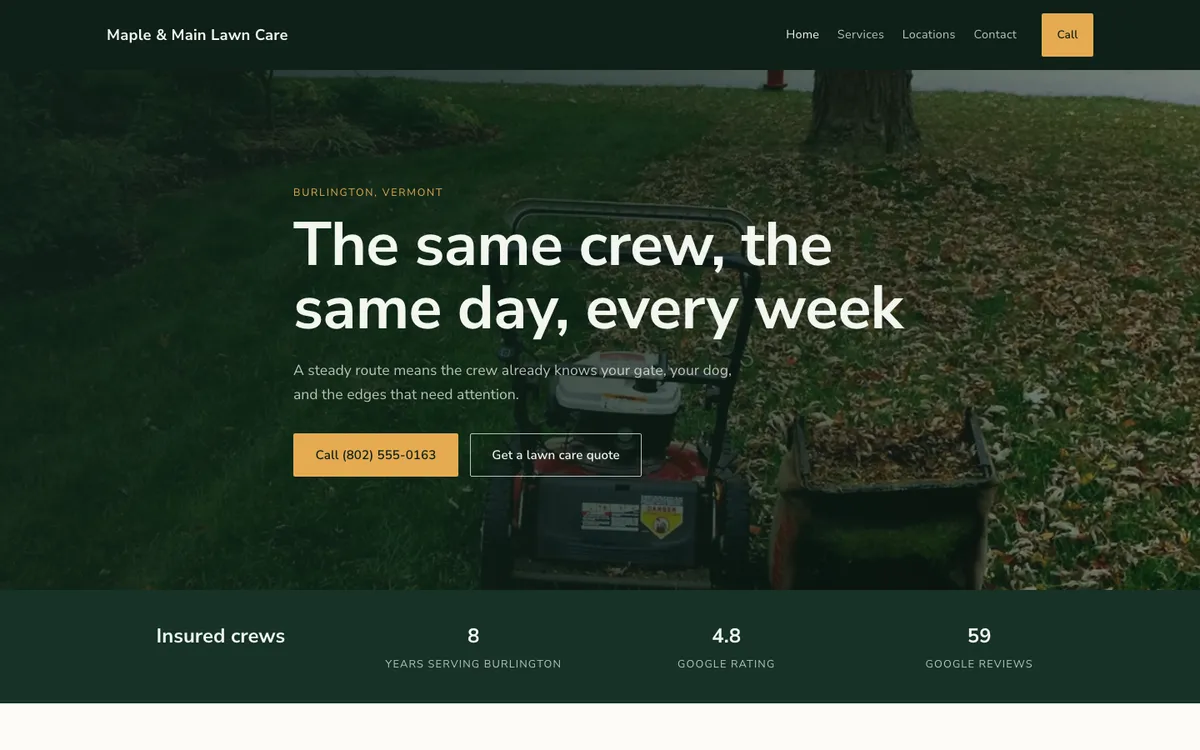
A homeowner can’t easily judge whether a quote is fair, but they can absolutely judge whether a finished yard looks good — and they’re judging your photos as a stand-in for that. A generic stock-photo hero of a green lawn tells a visitor nothing. A photo of the actual crew, the actual equipment, in the actual neighborhood, tells them this is a real outfit that does this every week.
Before-and-after, labelled by project — not a stock photo wall
A gallery that’s just twelve identical close-ups of mulch tells a visitor nothing they couldn’t get from a stock photo site. A gallery that pairs a real before shot with a real after shot, with one sentence underneath — what was there, what changed, roughly where — reads as proof instead of decoration. Group it by project, not by photo.
You’re really running two businesses on one site
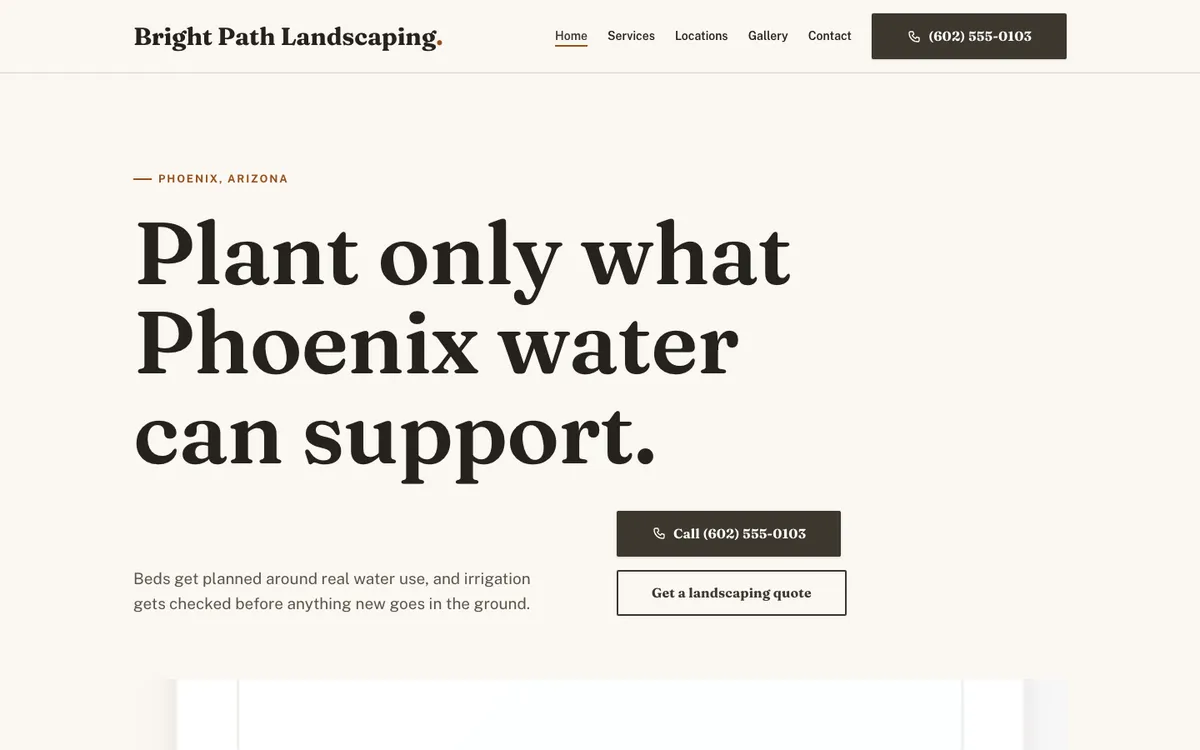
Design-and-install is sold on vision: renderings, before-and-afters, a conversation about what the yard could become. It’s a one-time, higher-ticket decision, and the person making it is usually picturing the finished result more than they’re pricing out materials. Maintenance is sold on reliability: the same crew, the same day, a schedule that doesn’t slip. It’s recurring and lower-ticket, and the proof that matters is consistency, not imagination — a maintenance customer isn’t hiring you to reimagine their yard, they’re hiring you to make sure it never becomes a problem they have to think about. Trying to sell both with one page usually undersells both — give each its own page, with its own photos and its own kind of proof.
The phone call is usually about one of two things, and they’re easy to tell apart once you’re listening for it: a maintenance caller wants to know when the crew can start and whether you service their street, and a design caller wants to talk through an idea before they’ll even consider a price. A site that answers the scheduling question fast — service area, typical start time, how billing works — keeps the first caller from bouncing to a competitor while they wait on hold. A site that shows enough finished work to make the second caller comfortable booking a site visit does the same for the other kind of job.
Pages worth having
The same logic that keeps a roofer’s repair page separate from their replacement page applies here — each of these is a different search, from a different kind of visitor, who wants different proof:
- Lawn care / mowing — the recurring route, sold on schedule and consistency. This is the page that should answer “when can you start” before anyone has to call and ask.
- Design & install — the one-time project, sold on photos and vision. This is where the before-and-after gallery belongs.
- Hardscape — patios, walls, walkways; usually its own higher-ticket decision with its own materials conversation.
- Irrigation — installation and seasonal turn-on/turn-off, which is its own kind of call and often its own season.
- Tree work — often an urgent, safety-driven call (a limb over a roof, a leaning trunk) rather than a planned one, so it deserves a page that gets straight to the phone number.
- Seasonal clean-up — spring and fall, and snow removal where winters call for it; these are the pages most likely to be searched for in a narrow window, so they’re worth keeping current rather than folding into a general “services” list.
The quote process: site visit vs. phone estimate
Be honest about which jobs need an in-person look and which don’t. A design job, a hardscape project, or anything where the site’s slope and soil matter genuinely needs someone standing on the property. A standard mowing route can often be quoted from the phone or a couple of photos. Saying this plainly on the quote page sets the right expectation instead of making every visitor wait for a callback to find out.
Service-area honesty: drive time, not a circle on a map
List the towns you actually service on a normal week, not every town within some theoretical radius. A route built around drive time is a route a crew can actually keep to — which is the same promise “the same crew, the same day” is making above. Keep this list consistent with the service areas on your Google Business Profile; a mismatch between the two reads as unreliability to a search engine even when it’s just an oversight.
Write for the season someone is actually searching in
Spring brings clean-up and mulch searches, summer brings irrigation and drought questions, fall brings leaf removal, and winter brings snow where it snows. A site that only ever talks about “lush green lawns” reads as though nobody updated it since launch. Writing toward the actual season is one of the simplest ways a page stays specific instead of generic.
The website part, handled
Speedy Sites builds the kind of landscaping site this guide describes — real photos, separate pages for install and maintenance, honest service areas. $0 charged today, and the first 90 days are free. You’ll add a card before you can see the finished site, but nothing is charged until the trial ends — cancel any time before then and you won’t pay a cent. After that, it’s $99/month, or $891/year.
Build my website